Reclaiming Amazon Connect Calls from the PSTN Black Hole
By Kashafunnisa Bagewadi (Sr. Solution Architect, HiveTek), Zai Nasimi (COO, HiveTek), Kaley Kaukinen (PSA, AWS), and DJ Kulkarni (Connect Specialist, AWS)
In hybrid contact-center environments, external transfers are often where visibility goes to die. When Amazon Connect hands a call off to the Public Switched Telephone Network (PSTN), the platform traditionally loses control the moment a third-party carrier-level voicemail answers.
This "PSTN Black Hole" doesn't just result in fragmented data — it creates a complete loss of the rich analytics provided by Amazon Connect Contact Lens. This article is a technical deep dive into reclaiming these interactions so every missed call stays inside your controlled AWS ecosystem for unified transcription and automated follow-up.
01 — The Problem
When Carrier Voicemails Hijack Your Data
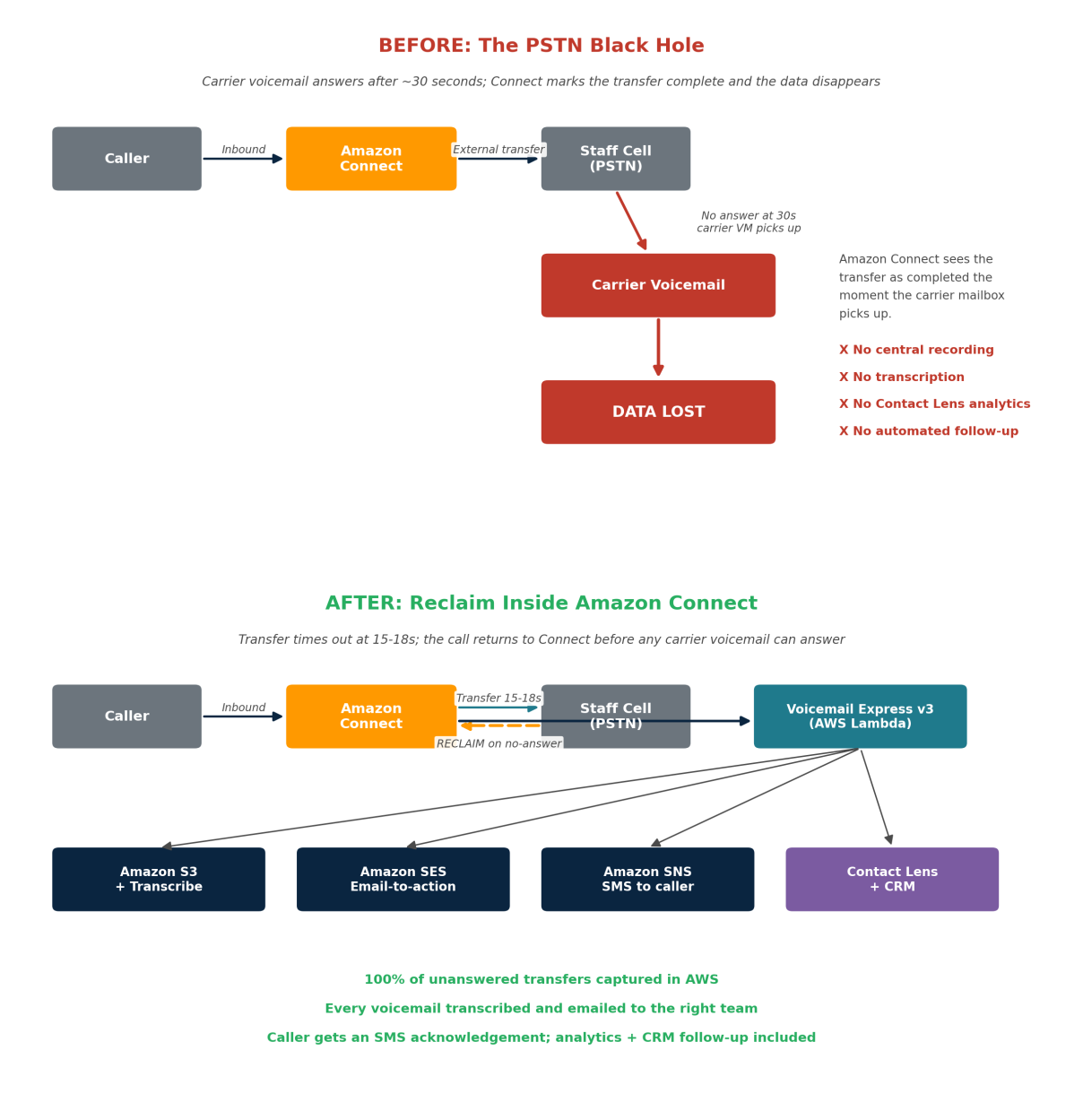
When an Amazon Connect instance routes a call to an external number — such as a staff member's business cell phone — the PSTN sees a "successful" connection the moment the carrier's voicemail picks up. Because the carrier system technically "answers" the call, Amazon Connect marks the transfer as completed and terminates the contact flow.
The result?
- Zero visibility: no central recording or transcription exists.
- Siloed data: critical customer messages are stuck on individual hardware.
- Workflow breakdown: you cannot trigger downstream AWS Lambda functions or CRM tasks.
02 — Where It Hurts
Which Workloads Feel the PSTN Black Hole First
Any Amazon Connect deployment that transfers callers to external numbers is exposed. The pattern shows up hardest in:
- Mission-critical intake lines — healthcare triage, crisis services, and social-service intake, where a missed message has real human consequences.
- Distributed workforces — field techs, home-health aides, case workers, and after-hours on-call staff who receive transfers on personal or business cell phones.
- Fundraising and revenue lines — donor and sales lines where a message stuck on an individual mailbox never becomes a follow-up task in the CRM.
- Hybrid contact centers mid-migration — teams that still route to legacy PBX or personal numbers while they consolidate on Amazon Connect.
In every case, the symptoms are the same: no transcription, no Contact Lens analytics, no downstream automation, and no reporting on what leadership can't see.
03 — The Technical Solution
Shortening External Transfer Durations
The core of this solution is a practical configuration change that limits the duration of the external transfer attempt. By timing the transfer to be shorter than the typical carrier "time-to-voicemail" (usually 20–30 seconds), we can force the call to return to Amazon Connect if a human does not answer.
STEP 1
Contact Flow Logic
Within your Amazon Connect Contact Flow, configure the Transfer to phone number block with a specific timeout. Setting this to approximately 15–18 seconds ensures the call is pulled back before the external carrier's voicemail triggers.
Contact Flow Block Configuration
In the Amazon Connect Contact Flow editor, open the Transfer to phone number block and set:
- Type: Voice
- Destination: the staff cell or external number (set with Set contact attributes upstream)
- Timeout: 15–18 seconds — the key value. Stay under the carrier's 20–30 second time-to-voicemail window.
- Resume contact flow after disconnect: Yes — this is what makes the reclamation possible.
- On no-answer branch: route directly into the Voicemail Express v3 contact flow.
STEP 2
Architecting Voicemail Express v3
Once the call is reclaimed, it is routed into the Voicemail Express v3 pipeline. This serverless architecture leverages:
- Amazon S3: for secure audio storage.
- Amazon Kinesis Video Streams (KVS): for real-time ingestion.
- Amazon Transcribe: to convert the voice message into actionable text.
STEP 3
Automation and CRM Integration
Once captured, use the output of the pipeline to trigger a Lambda function that:
- Creates a follow-up task in your CRM (Salesforce, Zendesk, etc.).
- Analyzes sentiment and intent using Contact Lens.
- Sends an automated SMS to the caller acknowledging their message and pointing them to additional resources.
04 — Summary of Learning
What You've Just Eliminated
By configuring Amazon Connect to reclaim calls from external carrier voicemails, you eliminate data silos. Every interaction benefits from unified transcription, advanced analytics, and automated workflows — regardless of where the call was originally headed.
05 — See It In Production
See This Pattern Applied to a Real Nonprofit
HiveTek deployed this exact reclamation pattern for a California-based youth homelessness nonprofit ahead of the 2025 Giving Tuesday campaign — reclaiming every unanswered external transfer inside Amazon Connect, delivering transcribed voicemails to the right team within minutes, and giving leadership real-time visibility into call volume for the first time.
Read the full customer story, architecture, and AWS building blocks in the case study: